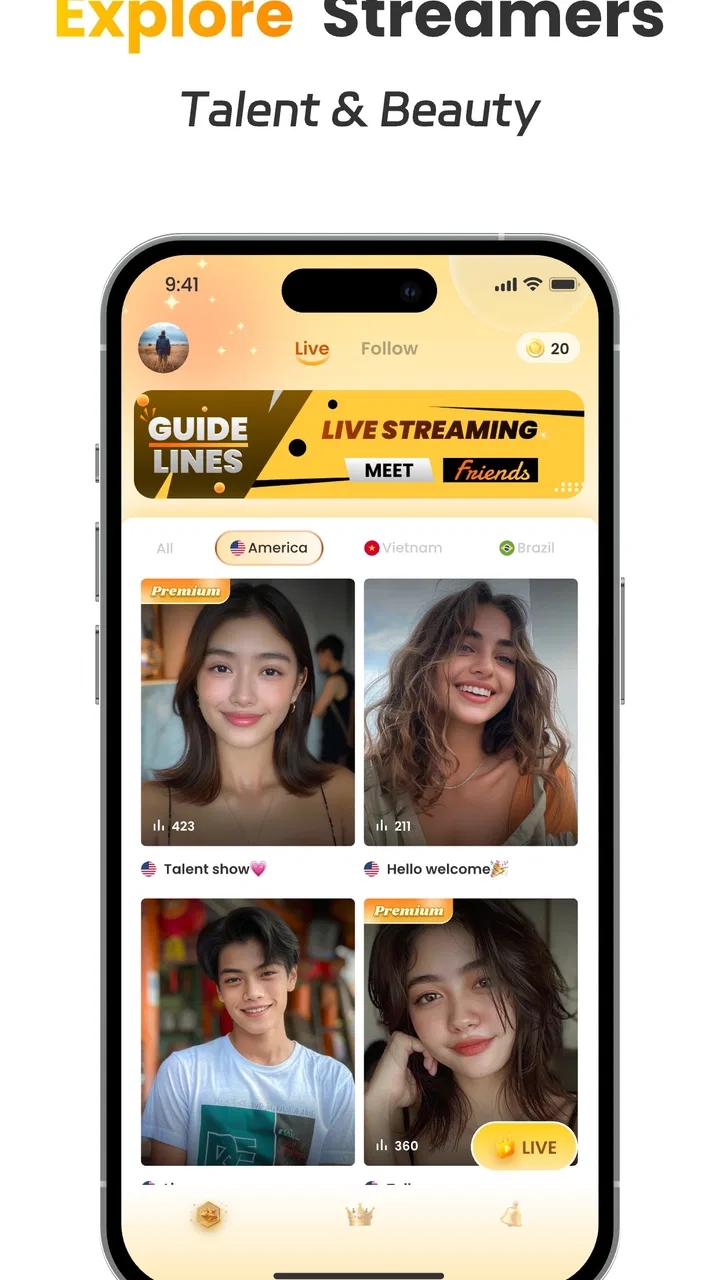
YahLive-Go Live in a Tap
- 4.6
- Rating
- 5.00M
- Installs
- Free
- Price

 Analysis by App-foxy
I spent time with YahLive-Go Live in a Tap as an entertainment app built around live social interaction, and my first impression is that it is more focused on immediacy than on being a polished all-purpose media hub. The idea is simple: open the app, find a live space that interests you, and take part without turning the experience into a complicated setup process. That makes it appealing when I want something spontaneous rather than a carefully edited video or a long streaming session.
The app is free to install, although it includes optional purchases ranging from $0.99 to $99.99 per item. It is aimed at mature audiences, with a 17+ content rating, so I would not treat it as a casual app for younger family members. FANLCO TECHNOLOGY LTD is the developer, and the current release is version 2.2.0. Those details matter because live entertainment changes quickly: the quality of the experience depends not only on the interface, but also on the people broadcasting and the way each session is managed.
How YahLive feels in everyday use
What I like most is the low barrier between opening the app and reaching live content. Traditional entertainment apps usually make me choose between a large catalog, a recommendation feed, or a subscription plan. YahLive feels more present-tense. I am not simply selecting something that was recorded earlier; I am looking for an active moment and deciding whether I want to stay, watch quietly, or participate.
You May Also Like

 Blood Strike: 2.5 Anniversary
Blood Strike’s Loadouts Turn Every Drop Into a Tactical Gamble
A close look at Blood Strike’s custom loadouts: how fast access to signature weapons reshapes its battle royale rhythm, rewards preparation, and narrows the gap between fights.

 Pandora - Music & Podcasts
Pandora’s Music Is Easy to Start, but Harder to Recover
Pandora’s strength is its low-effort path from a seed to a station. Its weak spot is how much confidence it asks you to place in connection, setup, and quiet recovery.

 8 Ball Pool
 Is Built on Rivalries, Rematches, and Routine
A close look at the rivalries, rematches, shared routines, and unanswered safety questions that turn a quick pool match into a persistent mobile community.

 Samsung Music
’s Quiet Strength Is Playing What You Already Own
Its reach comes less from spectacle than from dependable access to a personal library. That simplicity is both the app’s strongest retention engine and its ceiling.

 AccuWeather: Weather Radar
AccuWeather Review: A Quick, Clear Forecast for Everyday Decisions
For everyday plans, the best forecast is the one you can understand quickly. AccuWeather makes rain timing, radar, and local conditions easy to act on, with a few trade-offs.

 Hill Climb Racing
Why Hill Climb Racing Still Turns Crashes Into One More Run
A tiny car, a bumpy hill and one more upgrade: Hill Climb Racing keeps resurfacing because its simple chaos makes every near-miss feel personal.
More From Our News Desk



That difference changes how I use it. I would open it during a short break, browse for a few minutes, and leave if nothing caught my attention. I would not approach it like a service for a planned two-hour film night. Its strength is the possibility of discovery, while its weakness is that discovery can be uneven. A live session can be engaging because it feels personal, but it can also be less structured than a finished program.
A realistic example is an evening when I have already finished my routine but do not want to commit to a full episode or a long video. I can check what is happening, spend time in a live room that has a comfortable atmosphere, and close the app whenever I am ready. That flexibility is useful, especially for people who prefer short visits instead of fixed viewing schedules.
The most important trade-off is spontaneity versus predictability. If I want a guaranteed subject, exact runtime, consistent production quality, or reliable background listening, a conventional video platform is usually the safer choice. If I want the feeling of entering an active social space, this app has a clearer reason to exist.
Who will get the most from it
I think YahLive is best suited to adults who enjoy live interaction and are comfortable deciding for themselves which sessions deserve attention. It can work well for someone who likes meeting different personalities through broadcasts, checking in briefly throughout the day, or using live entertainment as a social break rather than as a formal viewing appointment.
It is also a reasonable fit for users who find ordinary entertainment feeds too passive. Recorded clips are convenient, but they remove the sense that something is unfolding now. Live content can create a stronger feeling of presence, even when the actual activity is simple. That is the specific appeal I noticed here: the app is less about collecting finished media and more about entering a current conversation or performance.
I would be more cautious recommending it to anyone who dislikes unplanned content, wants strict control over what appears on screen, or expects every session to feel professionally produced. The 17+ rating should also be taken seriously. Adults should still use their own judgement about the people they interact with and the amount of personal information they choose to share in a live environment.
What the current release tells me
Version 2.2.0 gives the app a reasonably current foundation, and I see that as a sign that the product is still being shaped rather than treated as a finished, static utility. The release date was December 11, 2024, so the app is relatively recent compared with long-established entertainment platforms. That makes the current experience interesting, but it also means I would judge it by what it does today rather than by assumptions about where it might go.
The public response is encouraging: YahLive has a 4.6 average from around 22 thousand ratings, with over 5 million installs. I read those figures as evidence that the basic concept is connecting with a substantial audience, not as a guarantee that every live room will suit every person. Live apps are highly dependent on timing, community habits, and individual taste. A well-liked platform can still feel quiet or repetitive during a particular visit.
The app’s short store description, “YahLive,” says very little, while its broader summary presents the service as a way to bring the world closer. In practice, I think the useful interpretation is narrower and more realistic: it brings users closer to live social entertainment when the right broadcaster or room is available. That distinction helps set better expectations. It is not a replacement for every kind of communication or media consumption.
Changes and product maturity
Because the current version is 2.2.0, I look at YahLive as a product that has moved beyond an initial experiment but is still early enough for the experience to evolve noticeably. I would expect the developer to pay attention to discovery, moderation, stability, and the balance between watching and participating. Those are the areas that determine whether a live app becomes part of a routine or remains an occasional curiosity.
I cannot treat a version number by itself as proof of a particular feature change, so I focus on the present experience rather than inventing a release history. What I can say is that the current build presents a straightforward live-entertainment proposition: access is free, the audience is mature, and optional purchases are part of the model. That combination makes the app easy to try, while also making it important to understand how quickly casual use can become spending if a user engages heavily with paid items.
My practical advice is to explore the free experience first and decide what value you actually receive before buying anything. I would set a personal limit in advance, especially because the upper end of the listed purchase range is much higher than the cost of a casual one-time add-on. This is not a criticism unique to YahLive; it is simply a sensible habit for any live service where interaction can encourage impulse decisions.
How existing users may experience the evolution
For someone already using the app, the biggest benefit of a newer release is not necessarily a dramatic visual change. It is whether opening the app feels dependable, whether finding an interesting live session takes reasonable effort, and whether the social side remains comfortable rather than overwhelming. Those are the details that shape repeat use.
New users may notice the app differently from early adopters. A growing audience can make live entertainment feel more active and varied, but it can also increase the amount of browsing required. More choice is not automatically better if the discovery process does not help me quickly understand why a session is worth joining. I would therefore judge the app after several visits at different times, not after one unusually good or bad session.
There is also a habit change worth considering. With recorded entertainment, I usually save something for later. With live content, postponing may mean missing the moment entirely. That can make YahLive feel more engaging, but it can also create pressure to keep checking. I recommend treating it as an optional leisure app rather than something that deserves constant attention.
Another useful approach is to separate watching from social participation. I do not have to interact every time I open a live app. Quiet observation can be enough, and it lets me learn the tone of a room before deciding whether I want to say anything. That small pause is valuable in a mature-rated environment, where the atmosphere may vary considerably from one live space to another.
Where it still falls short
The main limitation is the unpredictable quality of live content. A recording can be edited, paced, and checked before publication. A live session has none of those advantages in the same way. Some broadcasts may feel natural and entertaining, while others may be repetitive, noisy, or simply not suited to my mood. The app cannot remove that basic uncertainty without losing the live character that makes it different.
I also would not choose it as my primary source for structured learning, detailed news, or carefully produced storytelling. Those uses benefit from organization and editorial control. YahLive is more convincing when I want human presence and immediacy. When I need accuracy, depth, or a predictable sequence, another category of app will serve me better.
The mature rating creates another boundary. Adults may appreciate having a service designed for an older audience, but that rating does not mean every interaction will automatically be comfortable or worthwhile. I would avoid sharing sensitive personal details, remain alert to manipulative requests, and leave any live space that feels inappropriate. The social element is part of the appeal, but it also requires more judgement than watching a conventional program.
Cost is a potential source of friction as well. The free entry point is helpful, but optional purchases can change the way a user evaluates the app. If I begin to measure every interaction by what I might buy or receive, the entertainment becomes less relaxing. I prefer using the free access to decide whether the community and live content are valuable on their own, then treating purchases as an optional extra rather than a requirement for belonging.
Compared with mainstream video platforms, YahLive is less predictable but potentially more personal. Compared with messaging apps, it is more entertainment-oriented and less focused on private conversations. Compared with traditional television, it offers more participation and less editorial structure. None of those alternatives is universally better; the right choice depends on whether I value control, polish, privacy, or immediacy most.
Practical ways to use it well
My first tip is to give the app more than one short visit before forming an opinion. Live activity changes, so one quiet session does not represent the whole service. I would check it at different points in my routine, then notice whether I am finding genuinely different experiences or simply repeating the same browsing pattern.
My second tip is to decide what kind of visit I want before opening it. If I have ten minutes, I can browse casually and leave without feeling that I need to find the perfect broadcast. If I have more time, I can stay with a session long enough to understand its atmosphere. This simple distinction prevents the app from becoming an endless scroll through live rooms.
Third, I would use observation as a filter. Instead of immediately participating, I would spend a moment seeing how the host and audience communicate. That helps me avoid rooms that do not match my comfort level and makes any later interaction more intentional. It is a small workflow, but it is more useful here than treating every live session like a standard video recommendation.
Fourth, I would keep purchases separate from emotional reactions. Live entertainment can make a user feel involved quickly, particularly when a host acknowledges the audience. I would wait before spending, review my own limit, and ask whether the item adds lasting value or only satisfies a momentary impulse. This is especially important because the app is free to start but offers purchases across a broad price range.
Finally, I would protect the role the app has in my day. A short live visit can be a pleasant break, but constant checking can turn spontaneity into distraction. I find YahLive most enjoyable when I choose to open it, rather than when I feel obliged to monitor what might be happening.
What I would watch as the app develops
For future releases, I would pay closest attention to how the app handles discovery. The better it becomes at helping me find suitable live spaces without removing the surprise of browsing, the more useful it will feel. I would also watch for improvements in the balance between active participation and comfortable passive viewing. Not every user wants to perform, chat constantly, or spend money.
Community quality will matter just as much as technical progress. A larger audience can make the service livelier, but long-term trust depends on whether users feel respected and able to leave uncomfortable interactions easily. Since the app carries a 17+ rating, mature presentation and responsible user behaviour should remain central to the experience.
I would also look for clearer value around optional purchases. Free access is a strong way to let people understand the service, and transparent spending choices help preserve that advantage. If the app keeps the core experience enjoyable without making purchases feel necessary, it will be easier for me to recommend it to friends.
My recommendation
After using it, I see YahLive as a worthwhile option for adults who want live social entertainment that feels immediate and less scripted than ordinary video feeds. Its free starting point makes trying it easy, and the strong user response suggests that the concept has found an audience. The current version feels like a developing service with a clear identity rather than a generic entertainment catalog.
I would recommend it to a friend who enjoys discovering live personalities, checking in for short bursts, and accepting that not every visit will produce a memorable session. I would not recommend it to someone who wants guaranteed quality, tightly controlled content, private communication, or entertainment with no possibility of extra spending.
My final view is positive but measured. YahLive works best when I use it for what it is: an adult-oriented doorway into live moments, not a replacement for every other media app. Approach it with realistic expectations, browse patiently, protect your privacy, and set a spending boundary before interacting deeply. Used that way, it can add a welcome sense of presence to otherwise ordinary downtime.
FAQs for YahLive-Go Live in a Tap
01What is YahLive-Go Live in a Tap?
YahLive-Go Live in a Tap is a social live-streaming app designed for users who want to broadcast themselves, interact with viewers, and discover live content from other creators. Depending on the available features and region, users may be able to chat in real time, follow broadcasters, send virtual gifts, and build a personal audience through regular live sessions.
02Is YahLive-Go Live in a Tap free to download and use?
The app may be available to download at no initial cost, but some features can involve optional in-app purchases. Live-streaming platforms commonly offer virtual gifts, premium interactions, subscriptions, or other paid items. Before spending money, review the pricing information shown inside the app and check whether purchases require confirmation through your Google Play or App Store account.
03Do I need to create an account to watch or start live streams?
An account may be required for interactive functions such as starting a broadcast, commenting, following creators, sending gifts, or saving preferences. Some versions may allow limited browsing without registration, although access can vary by platform, location, and app update. When creating an account, use a secure password and review the permissions and profile information requested.
04Is YahLive-Go Live in a Tap safe for children and teenagers?
Because the app contains user-generated live video and real-time chat, content may change quickly and may not always be suitable for children. Parents should check the official age rating, privacy settings, moderation tools, and account controls before allowing use. It is also important to explain that users should never share addresses, school details, passwords, or private contact information during a broadcast.
05What permissions and internet connection does the app need?
A live-streaming application normally needs a stable internet connection and may request access to the camera and microphone when you broadcast. It can also require notifications, storage, or photo and video access for profile and content features. Review each permission carefully, grant only what is necessary, and use Wi-Fi when possible because live video can consume substantial mobile data.
Pros
- Simple interface makes starting a live stream quick for beginners.
- Supports real-time interaction with viewers through live chat.
- Useful for discovering broadcasts and meeting creators worldwide.
- Instant notifications can help you follow favorite live hosts.
- Mobile-first design works well for casual streaming on the go.
Cons
- Streaming can consume significant mobile data and battery power.
- Content quality may vary widely between different live broadcasts.
- Public chats may include inappropriate comments or unwanted interactions.
- A stable
- fast connection is needed to avoid buffering or stream drops.
- Privacy settings should be checked carefully before sharing personal details.

YahLive-Go Live in a Tap
Gallery